
Divine Word Missionaries
The Founding Generation
Founding Generation
|
|
|
Back to |
|
▪ Site Map ▪ Home |
 |
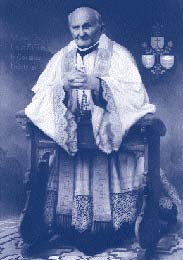
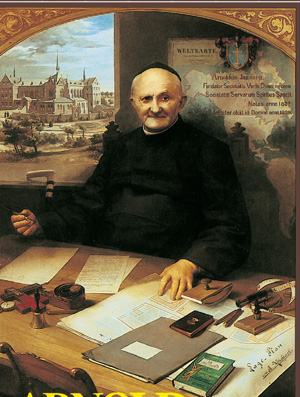
 THE FOUNDER OF THE RELIGIOUS CONGREGATIONS OF STEYL THE FOUNDER OF THE RELIGIOUS CONGREGATIONS OF STEYLArnold Janssen Serving the Universal Church |
 Arnold Janssen Arnold Janssen(1837–1909) Founder of
canonized on October 5, 2003 |
 |
“To Proclaim
the Good News
is the first and greatest act
of love of neighbor.”
Arnold Janssen
|
A.J. |
Significant Dates |
| November 5, 1837 | Arnold Janssen born in Goch |
| 1848-1855 | Primary school in Goch and minor seminary Gaesdonck |
| July 11, 1855 | School leaving examination, Muenster |
| 1855-1859 | Studies in mathematics, natural sciences, and philosophy in Muenster and Bonn |
| 1859-1861 | Theology studies in Bonn and Muenster |
| June 16, 1859 | High school teaching qualification |
| August 15, 1861 | Ordained priest in Muenster cathedral |
| 1861-1873 | Teacher at Bocholt public school |
| 1866 | Member of Apostleship of Prayer. Start of intensive promotion, traveling and publishing in German speaking areas of Europe |
| 1873-1875 | Chaplain to the Ursulines in Kempen |
| 1874 | Mission magazine Little Messenger of the Sacred Heart |
| December 3, 1874 | Permission to found a mission house in Roermond diocese (Netherlands) |
| September 8, 1875 | Inauguration of St. Michael’s Mission House in Steyl |
| January 27, 1876 | Inauguration of the Steyl Mission Press |
| 1878 | Periodical Die heilige Stadt Gottes |
| 1878 | Acceptance of the first lay brother postulants |
| March 2, 1878 | First missionaries sent to China: Joseph Freinademetz and John B. Anzer |
| 1884-1886 | First General Chapter and establishment of the Society of the Divine Word (SVD) Arnold Janssen Superior General for life Successive acceptance of mission territories on all continents |
| December 8, 1889 | Foundation of the Missionary Sisters |
| December 8, 1896 | Foundation of the Sisters of Perpetual Adoration |
| January 15, 1909 | Death of Arnold Janssen in Steyl |
| October 19, 1975 | Beatification of Arnold Janssen and Joseph Freinademetz by Pope Paul VI |
| October 5, 2003 | Canonization of A. Janssen and J. Freinademetz by John Paul II |
Saints -
God’s presence, God’s face
The Second Vatican Council states: In the lives of the saints “God vividly manifests his presence and his face. He speaks to us in them, and gives us a sign of his kingdom, to which we are strongly drawn, having so great a cloud of witnesses over us and such a witness to the truth of the gospel. Nor is it by the title only of example that we cherish the memory of those in heaven, but still more in order that the union of the whole Church may be strengthened in the Spirit by the practice of fraternal charity (cf. Eph 4:1-6). For just as Christian communion among wayfarers brings us closer to Christ, so our companionship with the saints joins us to Christ, from whom as from its fountain and head, issues every grace and the very life of the people of God.”
The purpose of canonization is to highlight God’s presence in our lives, our communion with Jesus Christ, and the unity of the entire Church in God’s Spirit as a sign of his kingdom in this world.
Without this qualification the saints we look up to would all too easily be seen as “faultless super beings,” with “magical powers of assistance” attributed to their intercession in every possible situation. As real people, however, the saints’ first “task” is to be a living sign of the liberating and healing presence of God in our own daily life as the people and family of God. Through their being and doing, their strengths and weaknesses, they show us the way.
God speaks to us in the lives of the saints in very diverse and often unexpected ways. It was so with Saint Arnold, through his unspectacular life God wrought the extraordinary.
W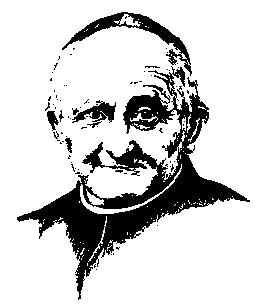 hat, we may ask, distinguishes this rather
plain and at times awkward character,
Arnold Janssen, as a saint? The surprising
but pertinent answer of Cardinal Rossi, official
postulator for Arnold Janssen’s beatification in 1975, was:
“He did ordinary things in an extraordinary manner.”
hat, we may ask, distinguishes this rather
plain and at times awkward character,
Arnold Janssen, as a saint? The surprising
but pertinent answer of Cardinal Rossi, official
postulator for Arnold Janssen’s beatification in 1975, was:
“He did ordinary things in an extraordinary manner.”
In that way the not particularly charismatic high school teacher, Arnold Janssen, became the founder of a religious family that today numbers 10,000 women and men from every continent and many cultures.
In the life and work of Saint Arnold, God reveals himself as the God of life for all, as God who is “Good News” for all people. To live that message and pass it on in word and deed was Saint Arnold’s passionate desire and enduring legacy.
“It was not me but the Lord.”
How Arnold Janssen saw himself
and his work
“This vineyard, beloved confreres, is our Society with all the fields of ministry entrusted to it. The hand of the Lord planted and cared for this vineyard; sunlight, rain and growth were given to it by the Lord. I cannot credit myself with anything in it except my poor collaboration, and even that was not my own merit. The idea did not come from me, nor did the perseverance to hold on to it amidst great difficulties, the powerful help in carrying it out and the support amidst general mistrust. It was not me but the Lord who awoke the vocations and enabled the individuals to remain faithful to their resolution. And if it had not been for the Lord, who would have sent the necessary financial support, and that amidst needs that grew greater from day to day! Truly, it must be the firm conviction of each one of us: the foundation, preservation and further development of our Society has no other author than He who dwells in heaven and directs and guides all things on earth.”
Arnold Janssen in a report to SVD Missionaries
in China in 1886
Arnold Janssen and his Times
“We live in a time when everything seems to be shaking and sinking. Now you are coming and want to start something new!” was the response of Archbishop Melchers of Cologne in 1875 when Arnold Janssen asked him to support the foundation of a German mission house. He thought there were enough pagans in Cologne; “they should be converted first.”
The second half of the 19th century was a turbulent time: the peak of European nationalism, colonialism and imperialism. It was a time of magnificent cultural achievements, of the industrial revolution’s boundless belief in progress spurred on by inventions, discoveries and innovations in technology, production, medicine, agriculture, transportation and communications media. It was a time of upheavals in society caused by the workers’ movements. The European powers were busy dividing up almost the entire world among themselves. It was the time of Karl Marx, Friedrich Nietzsche and Charles Darwin.
Beginning in 871, the Catholic Church in Germany was caught up in the “kulturkampf” of Bismark’s new German Empire. New exclusion laws constantly and drastically curtailed the activities of priests, religious orders and Catholic associations.
At the same time it was an era of growing missionary enthusiasm all over Europe. A good number of mission congregations and undertakings date from that time. Geographically speaking, the European Church became the universal Church. In this situation of dramatic upheaval, Arnold Janssen recognized the signs of the times. Searching for God’s will, he gave a concrete and apt response through his life’s work.


Who was this man
Arnold Janssen?
EARLY YEARS
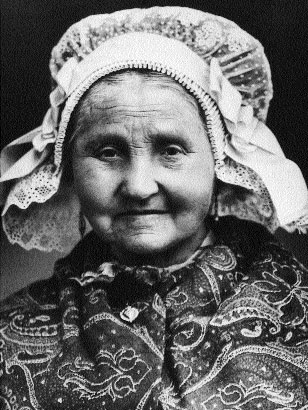
The second of eleven children, Arnold was born on November 5, 1837 in Goch, a small town in the German Lower Rhineland, near the Dutch border. His parents were Gerhard and Anna Katharina Janssen. He himself described his home life: “Apart from some very limited property of his own, my father’s land was mostly leased. He cultivated this with the aid of two horses. Beside the farm he had a freight hauling business and generally went to Nijmegen every week. When father was expected home, mother sent us out to meet him.” In this large family, Arnold Janssen learned early on to help with the work and to be undemanding and industrious.
A deeply prayerful faith and fidelity to the Catholic Church characterized and sustained the life of the Janssen family. This was especially evident in their devotion to the Blessed Trinity and veneration of the Holy Spirit. On his deathbed in 1870, Gerhard Janssen recommended this family spirituality to his children as his legacy: “Never miss High Mass on Sundays in honor of the Blessed Trinity to thank the Triune God for all the graces of the week, and attend Mass in honor of the Holy Spirit each Monday to implore the blessings of the Holy Spirit for the week.” Of his mother Arnold stated quite simply: “She had a great love of prayer.”
When Arnold was ten, the parish curate Heinrich Ruiter managed to persuade Arnold’s parents to send him to high school, first in Goch itself and then to the diocesan minor seminary Gaesdonck. Mathematics and natural sciences were his favorite subjects. In July 1855, not yet eighteen, he gained his school leaving certificate [Abitur] in Muenster.
|
1837 |
 |
|
|
|

STUDENT DAYS
HIS GOAL: TO BE A PRIEST AND TEACHER
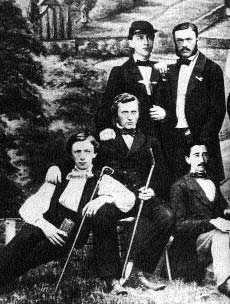 |
1857 Arnold Janssen (center) as a student with fellow students. He studied natural sciences, philosophy and theology in Muenster and Bonn. |
After gaining his school certificate Arnold went to Muenster to study theology. Already at the end of the second semester, however, he wrote: “Now that the time has come to make a decision – whether I will start theology now or later – I have firmly made up my mind to study mathematics and the natural sciences in order to get a degree in these subjects and then go on to theology.”
That set a clear goal to the path he had begun when he started at the diocesan high school. He wished to become a priest and high school teacher. The bishop was also in agreement with this. Consequently he began studies in Muenster in the fall of 1855, then continued in Bonn, studying mathematics, natural sciences and philosophy with his accustomed thoroughness and determination. In 1859 he was already qualified to teach these subjects at high school level. He transferred back to the major seminary in Muenster and began theology studies. On August 15, 1861 he was ordained priest.
“Worthwhile indeed is the life of one
who gives his all.”
 No particularly unusual events are reported from Arnold
Janssen’s student days. In 1858 he entered a paper in a mathematics
competition at Bonn university, which won first prize and
was accepted as his examination paper for the teaching diploma.
He invited his elderly father to attend the award giving ceremony.
“He was delighted that my work was so successful.” His
upbringing and training at home and in the minor seminary had
obviously taught him how to avoid the “dangers of the student
life.” From our point of view today, what he wrote from Bonn to
the rector of the minor seminary in 1857 sounds positively ascetic:
“My life at the local university is
extraordinarily simple and unvarying.
I go to church every day, then study
until almost nine o’clock. After that I
walk through the lovely avenue to the
college in Poppelsdorf and two hours
later walk back again. At four o’clock
I attend an afternoon seminar where
discussions or lectures are held. I do
not visit pubs or student gatherings.
Our only relaxation is walking to a
neighboring village on a nice Sunday
afternoon where we drink a cup of coffee and play a game of
dominos. I often fondly recall my time at Gaesdonck. Indeed,
now that I enjoy total academic freedom here, its memory has
become even more precious.”
No particularly unusual events are reported from Arnold
Janssen’s student days. In 1858 he entered a paper in a mathematics
competition at Bonn university, which won first prize and
was accepted as his examination paper for the teaching diploma.
He invited his elderly father to attend the award giving ceremony.
“He was delighted that my work was so successful.” His
upbringing and training at home and in the minor seminary had
obviously taught him how to avoid the “dangers of the student
life.” From our point of view today, what he wrote from Bonn to
the rector of the minor seminary in 1857 sounds positively ascetic:
“My life at the local university is
extraordinarily simple and unvarying.
I go to church every day, then study
until almost nine o’clock. After that I
walk through the lovely avenue to the
college in Poppelsdorf and two hours
later walk back again. At four o’clock
I attend an afternoon seminar where
discussions or lectures are held. I do
not visit pubs or student gatherings.
Our only relaxation is walking to a
neighboring village on a nice Sunday
afternoon where we drink a cup of coffee and play a game of
dominos. I often fondly recall my time at Gaesdonck. Indeed,
now that I enjoy total academic freedom here, its memory has
become even more precious.”
PRIEST AND HIGH SCHOOL TEACHER
IN BOCHOLT (1861-1873)
 |
1865 Arnold Janssen as a young priest and high school teacher in Bocholt. |
The 24-year old, newly-ordained priest Arnold Janssen began teaching at the secondary school in Bocholt in October 1861. The school was just being reorganized. His teaching activity, to which he brought his characteristic thoroughness and conscientiousness, kept him fully occupied, especially during his first years in Bocholt. He was also responsible for the staff library and the scientific collections which he built up and extended in exemplary fashion. In addition he helped with the parish pastoral ministry.
Arnold Janssen was qualified to teach mathematics and natural sciences in all high school grades, something that was not common among the priests of the Muenster diocese. Yet in spite of that, in twelve years of teaching he was never called to one of the more prestigious schools. Nor was he ever class teacher, although he often gave half of all classes in the higher grades.
He was the “little priest,” as the people of Bocholt called him. He was barely one meter sixty-five tall (approx. 5ft 5in), and of slender build. At the physical examination for military service he was judged to be “unfit due to general weakness of body and chest.” All in all, he did not cut an imposing figure.
Added to this, as the director of the school in Bocholt later recounted: “He prepared well for his classes, kept the laboratory instruments in good condition, practiced the experiments himself, and carefully corrected the written assignments. But he did not know how to win the hearts of his students. They were repelled by the way he punished.” On the other hand Arnold Janssen was known as a man of indefatigable prayer. Thus “Fr. Janssen was always a man of prayer but not very sociable or accessible. As a rule Fr. Janssen was late for the midday meal because he liked to squeeze in the Way of the Cross between school and lunch.” And a former student recalled: “We students knew even then that he prayed whole nights through. Of course then it could happen that he was overcome by sleep during the French lesson. Then we would say: ‘Janssen stayed up again last night.’ He never failed to keep impressing on us: ‘Pray, always pray much.’ Daily you saw him praying the Way of the Cross twice; once before and once after the noon meal. I think he got his apostolic spirit from that.”
It is not surprising, therefore, that he himself began to doubt whether he was in the right place. Looking back at his time in Bocholt, Arnold Janssen gave a deep insight into his basic attitude when he recounted: “Formerly when I was in Bocholt, I thought, Why be a teacher? Why not be somewhere else where you could do more good? But my bishop said to me, Divine Providence is leading you. So I did not brood and did what was incumbent upon me. Later, when establishing the Mission House, it dawned on me that I had been in the right place after all to prepare me for my future work.”
Materially speaking Arnold Janssen lived a very modest lifestyle during his years in Bocholt. First he had to repay his study grants for Bonn and Muenster. From 1865 on he paid for his brother John, 16 years his junior, to attend school and university. This alone took up more than ten percent of his salary. From April 1866 he also used considerable amounts in traveling and publishing activities for the Apostleship of Prayer, to which he dedicated himself along with his teaching profession. This additional commitment was to give his life an unexpected new direction.
MAN OF PRAYER AND TRAVELING APOSTLE
PROMOTER OF THE APOSTLESHIP
OF PRAYER
From the outset prayer had a profound significance in Arnold Janssen’s life, first in the example of his parents, later in the minor seminary and then during his university studies. As teacher and priest, his basic attitude was that of a man of constant prayer. It enabled him to see beyond his own human inadequacies, to be strong in the face of setbacks, and misunderstandings, to give up securities and to take up new challenges. The conviction that “it was not me but the Lord,” was the focus around which his life and activity centered – not only when looking back on achievements but also, and especially, when it came to accepting what, humanly speaking, had not succeeded.
The Apostleship of Prayer was founded by a group of Jesuit professors and students in the south of France in 1844. They aimed to lead ordinary people into prayer as a kind of school and training ground for lived faith. The Messenger of the Divine Heart of Jesus was an information bulletin sent to the members. The first issue of the bulletin appeared in June 1861, shortly before Arnold Janssen’s ordination. In April 1866 he formally joined the movement. His certificate of membership stated, “Arnold Janssen has been accepted as a promoter of the veneration of the Most Sacred Heart of Jesus and the Apostleship of Prayer.”
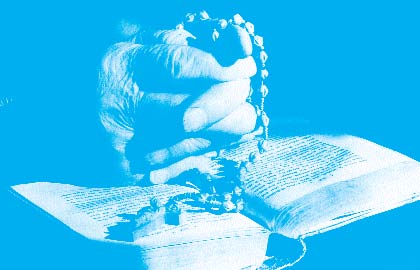
That was not enough for him, however. He related, “When the General Assembly of Catholic Associations of Germany was held in Innsbruck (Austria) in 1867, I went on a long holiday trip there. On that occasion I got to know Fr. Malfatti SJ, director of the Apostleship of Prayer for Germany and Austria. He asked me to take over the coordination of the association in the diocese of Muenster, and this I did. That same fall I visited the tomb of the Curé of Ars and the Industrial Exhibition in Paris. From then on I took special interest in the Apostleship of Prayer. ... I faithfully used my holidays to promote the Apostleship in the diocese of Muenster. I was also confirmed as diocesan director by the diocesan authorities. I worked especially for an increase in the spirit of intercessory prayer so that people would offer their usual prayers, for example the rosary, for the intentions of Jesus. … The Apostleship of Prayer was introduced into almost the entire diocese of Muenster. There was hardly a parish priest whom I did not visit for this purpose.”
“All is possible in the strength of the grace
of the Holy Spirit.”
His activities to promote the prayerfulness that he himself lived so perseveringly turned Arnold Janssen into a “traveling apostle.” As soon as the school holidays began, he was constantly on the road, often on foot. By 1873 he had reached 300 of the 350 parishes of the Muenster diocese – and far beyond. To his printing press in Paderborn he wrote in fall 1872: “I have traveled for five weeks during these holidays to promote the praying of the rosary according to the method described on the prayer card (or some other method). The success of the project has led me through the dioceses of Cologne, Trier, Luxembourg, Metz, Strasbourg, German-speaking Switzerland, Augsburg, Munich, Salzburg, Passau, Regensburg, Mainz, etc.”
That indicates a further, decisive ability and activity of Arnold Janssen that he developed in the course of his service to the Apostleship of Prayer, namely writing and publishing. Immediately after his acceptance into the Apostleship, he published a small brochure in Duesseldorf entitled: “Association of the Apostleship of Prayer for the Practice of Intercessory Prayer to the Most Lovable Heart of our Savior Jesus Christ.” The booklet appeared simultaneously in South Germany and Austria. He immediately sent one home to his family stating, “I have wanted to write for a long time. But I was always waiting for this… Read and pray diligently with this lovely booklet. And read and pray again and again until you understand everything.” One year later there was already a second edition (circulation 15,000) now bearing the title, “Admission Booklet of the Apostleship of Prayer and the Fraternity of the Most Lovable Heart of our Savior Jesus Christ.” By 1880 four further editions had been published, bringing the total to 90,000 copies. Along with that, he also published another series of pamphlets and prayer leaflets, including an introduction to the rosary, that enjoyed widespread popularity.
Arnold Janssen’s constant underlying principle in all this was: in praying their customary prayers such as the rosary, people are to be guided toward an attitude of intercession, so that they begin to converse with God about the great and small intentions of life and of the Church, receive orientation from God and find the path to concrete and active love of neighbor. Naturally, Arnold Janssen was expressing himself in the theology and language of his times. At first it was the contemporary, popular Sacred Heart devotion, but that drew him more and more to the contemplation of the Triune God. In the spirit of that time, the great intention that moved him was the “return to the faith of the separated peoples.” Though somewhat ahead of his day and age, he saw this unity as a fruit of the action and grace of God, which we must ask for in prayer.
“May the holy Triune God –
the Omnipotence of the Father, the Wisdom of
the Son, and the Love of the Holy Spirit –
be known, loved and praised by all people.”
In September 1869 Janssen attended the General Assembly of Catholic Associations in Duesseldorf. In his capacity as diocesan director of the Apostleship of Prayer for the Muenster diocese, he submitted a proposal that the Apostleship of Prayer be recommended for all German Catholics. His proposal was unanimously accepted, probably not least because of his personal dedication and publishing work. The Apostleship bulletin announced: “Thanks to the recommendation of the General Assembly, the Apostleship of Prayer has left the inner halls of asceticism to which it was confined in many areas and has now become more widely known.” First and foremost that applied to the life of Arnold Janssen himself.
Here if not sooner, a different Arnold Janssen, now 33 years old, came to the fore. The man known in the school in Bocholt as “a man of prayer but not very sociable or approachable,” the man who spoke only in the classroom and occasionally in a less important church, had become a man of the public arena who knew how to put his message across both personally and through the media. If in former times he had not found it easy to reach out to others, now he had not the slightest difficulty in knocking at the door of any parish house in order to speak about and win people for the Apostleship of Prayer. He had no inhibitions about approaching bishops and dignitaries with his message. His extensive travels and the great diversity of his contacts and encounters broadened his vision and thinking far beyond the narrow horizons of Bocholt.
Arnold Janssen’s situation in those years appears rather complicated: on the one hand he was imprisoned by the frustrating, prejudices about him as a not particularly successful nor recognized mathematics teacher and on the other hand, he felt challenged and highly motivated and confirmed in his life and service in the Apostleship of Prayer. On the one side, there was the security of his teaching position that apparently did not fulfill him, on the other side an insecure existence in the service of a task that he began to see more and more as his own.
A decision was finally provoked in 1873 through a conflict with the school board in Bocholt. It concerned a statue of the Madonna that Arnold Janssen himself had acquired as early as 1868 and wanted to set up in the school hall. It was a Catholic school but there were also Protestant and Jewish pupils. There were arguments this way and that between the school board and Janssen regarding the statue. In this connection, he requested the bishop of Muenster in 1870 to free him from the school so that he could devote himself to purely religious activities. At that time, the bishop refused. But not so in 1873. By that time the Kulturkampf was well and truly under way. In the new German Empire under Prussian leadership, the activities of the Catholic Church in schools was drastically limited at the end of 1871. There was definitely no place for a statue of the Madonna. Arnold Janssen stuck to his guns – and handed in his notice in March 1873.
FROM MISSION PERIODICAL
TO MISSION HOUSE
| 1874 Little Messenger of the Sacred Heart Arnold Janssen’s first mission periodical. |
 |
Arnold Janssen fulfilled his school obligations until the end of the academic year 1872/73. Then the 36-year old was free to begin a new phase of his life. In October 1873 he took a position as house chaplain for the Ursuline Sisters in Kempen who ran a boarding school. That gave him the necessary free time to do even more for the Apostleship of Prayer. In July 1873 he described his situation as follows: “I would have been prepared to make even greater efforts for that [the Apostleship], even to commit myself totally to this holy task, and to place all my strengths and abilities, even my life, at its disposal if only it could have moved the thrice holy and good God to pour out the Spirit of grace and prayer more richly on the world.” But he wanted to put into practice an idea that had already developed in Bocholt, “to publish a popular monthly periodical for the promotion of prayer and participation in the great intentions of the Divine Savior, especially the propagation of the faith.” With his customary thoroughness he set to work. His publishing experience stood him in good stead, as did his extensive contacts and relationships won through his activities for the Apostleship of Prayer. Already in January 1874 the first issue of his periodical, the Little Messenger of the Sacred Heart, was published. The title was taken from the Apostleship bulletin with the addition of the word “Little.” In the beginning Arnold Janssen had to pay for its publication from his savings. He described the goal of the magazine as: “The principal, if not the sole, goal of the undertaking is to inform people about the Catholic missions at home and abroad in a readable and interesting manner.” However, it quickly became apparent in the following issues that it was to be a magazine that mainly dealt with the “missions abroad.” In those days the term used was “pagan missions.” On the title page of the June issue there appeared for the first time Arnold Janssen’s emblematic prayer: “May the divine Heart of Jesus live in our hearts.”
A Momentous Encounter –
Janssen and the Universal Mission
In May 1874 a newspaper article caught Arnold Janssen’s attention. The Prefect Apostolic of Hong Kong, Bishop Giovanni T. Raimondi, was visiting Dr. von Essen, the parish priest of Neuwerk. “I visited him to get more detailed information about the missions and other things. I wanted to awaken and promote interest in the missions through the Little Messenger of the Sacred Heart. I told him of my regret that Germany, where Catholic life was so vigorous, did not have a single mission house for the training of missionaries. On the other hand, France, Italy, Belgium and even Britain, where Catholic life was so weak, did have such institutions. I myself could not go to the missions because I was too old. ‘But that is not necessary,’ replied Mgr. Raimondi, ‘some priests must stay at home to work for the cause in Germany.’ I thought then only of placing myself at the disposal of whoever would begin such an enterprise and of dedicating my energy to it. I visited Mgr. Raimondi again and we spoke about the same question. Finally, Mgr. Raimondi said that if no other German priest whom I could join was willing to undertake the project, then, trusting in the help of God, I should begin myself and team up with Dr. von Essen for that purpose. The notion of beginning such a project myself had never dawned on me. As a result I thought it was asking too much; I did not consider myself capable of it. Later Mgr. Raimondi visited me in Kempen and urged me even more pressingly to take up the task. I hesitated just as before. Nevertheless, I wanted to present the plan to the public through the Little Messenger of the Sacred Heart and try to arouse interest in it.”

Giovanni T. Raimondi, Prefect Apostolic of Hong Kong.
THE GERMAN MISSION HOUSE
BECOMES A REALITY
The idea would not leave Arnold Janssen’s mind. In the following issue of his Little Messenger of the Sacred Heart he came back to it time and again. As it happened, the collaboration with Dr. von Essen encouraged by Bishop Raimondi proved extremely difficult. One year earlier von Essen had already received permission from the Pope to found a German mission house. But the “chemistry” between von Essen and Janssen simply did not work. So Janssen took up the task alone. In the November issue of the Little Messenger of the Sacred Heart he appealed to his readers: “The establishment of a German house of studies for foreign missions proves more and more to be an indispensable necessity. At the moment many priests are being driven, so to speak, into distant lands. Therefore the establishment of a mission seminary in a safe, well-situated locality is now indispensable. There is no lack of advice from men who are well-informed by experience. This holy task would be relatively easy to carry out if only it is tackled courageously. The first and greatest difficulty is the matter of money. There is an offer of a well-located house with a garden. But how to buy it and set it up? The holier a work is, the more difficulties it usually meets. It will be like that in this case also. It is true that to be pious means to pray piously, but also to work piously with the talents received and to sacrifice piously insofar as conditions allow it.”
THE WAYFARER
During the following months, along with his work as editor of the Little Messenger of the Sacred Heart and his duties as chaplain for the Ursuline Sisters in Kempen, Arnold Janssen was either traveling tirelessly or working day and night on his correspondence. As was his nature, he attacked the work valiantly – with all his available means, abilities and connections. At the same time he went looking for a suitable house, financial means and collaborators, while thinking about the organization of that mission house and the training of the future missionaries. He obtained in succession (on long trips), the permission and recommendation of the Dutch, German and Austrian bishops and consulted other mission houses and congregations at home and abroad (Benedictines in Beuron, Picpus Missionaries, Scheutveld Mission Congregation, Mill Hill in London).
OPPOSITION AND RESERVATIONS
Few shared Arnold Janssen’s enthusiasm, however. It was a good idea but no one could see how Janssen, of all people, would successfully bring it about. How people thought and spoke about the plan and the planner becomes clear from a sarcastic remark the curate in Kempen, Fr. Fugmann, is supposed to have made to Arnold Janssen: “Yes, do that, you are called to it: Firstly you have the necessary obstinacy; secondly the necessary piety; thirdly you are sufficiently impractical.” Bishop Paredis of Roermond, in whose diocese Steyl was located, is reported to have remarked about Janssen’s request: “Father Janssen, chaplain to the Ursulines in Kempen has just been to see me. He wants to found a mission house. Just think of it – and he has nothing. He is either a saint or a madman.” The reaction of Archbishop Melchers of Cologne is also telling. When Arnold Janssen “presented his plan to establish a house for the foreign missions, the bishop first looked at him seriously and said, ‘We live in a time when everything seems to be shaking and sinking. Now you are coming and want to start something new?’ Fr Janssen replied, ‘We live in a time when much is collapsing, and new things must be established in their place.’”
“Consecration to God
is the great goal of our life.”
The evening after the first visit, the bishop is supposed to have told others, “Fr. Janssen was here today and wants to start a house for missionaries. He wants to convert pagans. Here in Cologne there are enough pagans. They should be converted first.” Arnold Janssen himself described his inner feelings during those months poignantly in a letter: “I, too, had a time of harsh struggles when it seemed to me that I would have to let myself be crucified. Added to that came physical ailments and a number of adversities. Yet it seemed to me that to give up would be to go against God’s holy will. That is why I kept going, went on working towards it. I do not doubt that God wants this work and that he is the true agent who is making use of our weak abilities for this purpose.”
ACQUISITION OF THE HOUSE IN STEYL
CONSECRATION TO THE SACRED HEART
With such a determined attitude the business progressed. Thanks to several large donations, it was possible to purchase a former, rather derelict inn and its grounds in Steyl in the Netherlands. Due to the Kulturkampf, any thought of a foundation in Germany at that time was out of the question. Arnold Janssen signed the purchase contract on June 16, 1875 – a symbolic date of great significance for him. On that day, the 200th anniversary of the appearance of the Sacred Heart to Margaret Mary Alacoque was solemnly celebrated throughout the Catholic world. A number of bishops and many Catholics consecrated themselves and their churches to the Sacred Heart. Arnold Janssen recounted, “It was decided to make this day the foundation day of the proposed missionary society. We resolved that each one of us, wherever he happened to be at the time, would consecrate himself to the Sacred Heart of Jesus for the goals of the mission house. We all did this. And on the afternoon of that day, I went to Steyl near Venlo to definitively conclude the purchase of the property for the mission house.”
At the time the community consisted of Arnold Janssen himself and three solitary individuals with an interest in the mission house: Pastor Peter Bill in Luxembourg, John Baptist Anzer, a seminarian in Regensburg, and Franz Xavier Reichart, a seminarian from Voralberg who was studying in Louvain, but who on the advice of his confessor did not make the consecration.
In spite of that, in the August 1875 issue of his Little Messenger of the Sacred Heart, Arnold Janssen described the memorable day for his readers: “The mission house will never forget its origin and it has as its stated goal to fulfill the grace-giving intentions of the divine Heart of Jesus. Still more does it feel compelled by its origins to call upon the Sacred Heart of Jesus more forcefully and, as a proof of this, to make the following beautiful words its motto: Vivat Cor Jesu in cordibus hominum! May the Heart of Jesus live in the hearts of all people! So be it. Amen.”
After laying this spiritual foundation, he began to develop an inner structure for the mission house. At the beginning of February 1875, only a few months after his decision to take on the task himself and even before others had shown any interest in joining, he wrote about his plan to the Propaganda Fide in Rome. In that letter it already became clear that his ideas far exceeded the customary vision of a “German mission house”: “I believe we cannot manage without the foundation of a religious congregation,” and further: “I wished, therefore, that if possible the center of this project would always be in Rome.” Still with nothing concrete in hand, he by-passed the contemporary ideas about a “national” mission institute. Clearly he had the vision of an “international” religious congregation with firm bonds, extending beyond the German-speaking areas.
In July 1875 Heinrich Erlemann moved to Steyl as the first occupant of the dilapidated inn. A trained carpenter, this first “mission candidate” of Arnold Janssen spent his first weeks repairing and furnishing the house. He was soon joined by Franz X. Reichart. On August 5,1875 Arnold Janssen, Fr. Bill and Franz Reichart gathered for the first time as the initial community in Steyl. They dealt with three points: the future statutes of the house, a draft letter to the bishops whose approbation had not yet been solicited, and the election of a provisional rector. The inaugural day was set for September 8, 1875.
On August 27 Arnold Janssen left the Ursuline Convent in Kempen and moved to Steyl. With him came his brother Juniper whose Capuchin monastery had been dissolved. In the ensuing years he was to prove a great help to Arnold.
Inauguration of St. Michael’s
Mission House in Steyl
In his sermon during the inaugural liturgy on September 8, 1875 Arnold Janssen declared: “Whether anything will come of it is known only to God. But we express our thanks to the Giver of all good things for having helped with this beginning. We hope that the house will attain its purpose. The simplicity of this beginning should not discourage us. The mightiest tree starts as a single seed and the strongest of giants was once a weak, whimpering baby. We know that with our present resources we cannot accomplish our task, but we hope the good God will provide everything we need. And he may do with us what he wills. If the seminary succeeds, we will thank the grace of God. If nothing comes of it, we will humbly strike our breast and confess that we were not worthy of the grace. Certainly it would be a pity if our efforts were in vain. Who knows whether anyone would try a second time. So I appeal to all those assembled here: What can we do? First, pray. Ask the Lord of the harvest. Secondly, sacrifice.”
INITIAL POVERTY
|
1875 |
 |
Years later Fr. Erlemann described the scene at the inauguration: “On the faces of the priests present, not only those from Holland, but especially those from Germany, doubt and misgiving showed clearly, as if they were saying: ‘What will become of this dream child?’ It struck me very much, because after the liturgical celebration, they all disappeared silently, without a word, almost without saying farewell to the few inhabitants of the dilapidated Ronck Villa. During the entire ceremony there was a very subdued mood which often found expression in all kinds of questions put to Rector Janssen and the few other members of the house. And who could blame them for their doubts about such a beginning. What was there to see at that time? A thin, weak priest as superior, an apprentice carpenter in blue overalls [Erlemann himself] and an exiled Capuchin Brother [Br. Juniper] and a few other workers hired to arrange the festivities, an old tumbledown house with miscellaneous furniture borrowed for the occasion and the banquet table with miscellaneous china, and a dug-up potato field that had provided the potatoes for the festive meal, and otherwise virtually nothing. That was meant to be a ‘German-Dutch Mission House’ whose solemn inauguration was reported in the newspapers.”
And Arnold Janssen himself said later, looking back on the first months in Steyl: “Almost everywhere people were saying nothing would come of this initiative, it was even impossible that anything could come of it. Personally I soon noticed that wherever I went, I was looked at with great pity, like a person suffering from eccentric ideas.”
CRISIS AND A NEW START
Public opinion was not the only depressing part of the new Mission House. During the first months of 1876, alongside the material poverty and the absence of new collaborators, life in the House was overshadowed by dramatic clashes within the small community. They concerned the general goal of the Mission House, but especially Arnold Janssen’s strict ascetical ideas about the way of life in the House and his position as superior. In the end they led to the departure from Steyl of Fr. Bill and the theology student Reichart at the end of April 1876, leaving Arnold Janssen and John Baptist Anzer to make a new start in May when they were able to agree on the goal and statutes: “The purpose of our society is the spreading of the word of God on earth, especially by evangelizing activity among those non-Catholic peoples where this activity would prove most fruitful. In the first place we mean the pagan peoples, especially those in the Far East.” And: “The name of our house is ‘St. Michael’s Mission House in Steyl’. However, the society itself is called … ‘Society of the Divine Word at the Service of the King and Queen of Angels’ … or briefly, ‘Society of the Divine Word’, ‘Societas divini Verbi’.”
“We cannot please God,
unless we become small; that is the great
message of the holy night of Christmas.”
They were able to reach a compromise regarding regulations for the house and for their life as a religious community, as well as inclusion of academic sciences in the training of future missionaries. On June 16, 1876, one year after their personal consecration to the Sacred Heart, Janssen and Anzer made a kind of perpetual profession on the basis of these statutes. The statutes were to remain valid until the First General Chapter of the Society, 1884-1886, at which the first Constitutions were worked out and ultimately attained papal approbation. The central idea for the new mission house was described by Arnold Janssen in the May issue of the Sacred Heart Messenger: “Some might say that for the Society a rapid increase in personnel and external expansion is desirable. That is definitely not our opinion. Our opinion is that above all else our house must grow in interior spirit and virtue. A missionary in a pagan country can achieve something worthwhile only when he is enlightened, pious and holy. Consequently our house must be built on the striving for perfection. This is the foundation that must be laid first of all. May the Mother of Holiness help us and send us people who come here mainly to work for their own sanctification.”

John B. Anzer and Joseph Freinademetz, Steyl’s first
missionaries to China, set out on March 2, 1879.
It was a fresh start that was aided by the arrival of high school students, theology students and newly ordained priests, including John Janssen, Arnold’s younger brother, whose studies he had paid for. John Baptist Anzer was ordained to the priesthood on August 15. In January they were already able to start a small printing press of their own in Steyl and in August work began on a sizeable new building. In spite of all the confusion and struggles of the beginning, the growing community in Steyl was fairly stable by the time it celebrated its first anniversary on September 8. Immediately afterwards Arnold Janssen attended the Catholic Congress in Munich, at which the new Mission House was most warmly recommended to “the interest and support of Catholics.” In Munich he also met the student John Baptist Jordan who briefly showed an interest in Arnold Janssen’s foundation but later founded the Salvatorians.
The small seed began to germinate. A year later, the then Vicar Apostolic of Central Africa, Daniele Comboni, founder of the Comboni Missionaries, visited Steyl. (Also canonized with Arnold Janssen and Joseph Freinademetz on October 5, 2003.) Six months later Bishop Paredis of Roermond, in whose diocese Steyl lay, also came to visit.
In August 1878 Joseph Freinademetz, a diocesan priest from South Tyrol, entered Steyl. With John Baptist Anzer he was sent out a year later, on March 2, 1879, as Steyl’s first missionaries to China. They went first to Bishop Raimondi in Hong Kong. Probably with great relief but also with pride Arnold Janssen could say in his homily: “So now, in accordance with its purpose, the Mission House is sending out its first missionaries. Let us hope that many others will follow them! … Divine Providence has brought it about that he (Bishop Raimondi) who played such a great role in the founding of the House is now receiving its first missionaries.”
“Missionaries are ambassadors of divine love.
They are to reveal the great deeds of God and
establish the kingdom of divine love.”
The Basic Pillars
of the Steyl Mission House
SCHOOL AND TRAINING
Beginning in February 1875, Arnold Janssen published in the Sacred Heart Messenger several articles describing the educational system he had in mind for the future mission house “as preparation for the missionary calling overseas.” In November 1875 he was able to report the arrival of the first three students. The school’s existential importance for the future of the Mission House quickly became apparent, since the expected “wave of entrants” from among the “unemployed, homeless” priests and theology students exiled by the Kulturkampf did not materialize. The Sacred Heart Messenger and the contacts Arnold Janssen had made while promoting the Apostleship of Prayer proved to be of inestimable value. A constantly increasing number of “mission students” came to Steyl. By the summer semester of 1879 there were already 60 students, in 1881 over 100, and in 1886 around 200. Initially, the school, like the Mission House itself, had to contend with poverty and a great deal of improvisation. Arnold Janssen himself and his first collaborators were the teachers and educators. His own (often painful) experience as a teacher and his experiences as a student in schools that were still developing became his basic starting capital – the school in Goch and the high school Gaesdonck were just beginning when he began there as a student, and it was the same in Bocholt where he began teaching in 1861. To cope with the swiftly growing number of students, extern teachers had to be employed. It was only in the mid-1880’s that there was sufficient SVD personnel.

Steyl: The poor little house of the beginnings becomes a large Mission
House.
The number of new students, even in the midst of the community crisis during the first months of 1876, forced the decision to add a large extension to the Mission House in Steyl. Work began in August. As was Arnold Janssen’s way, in spite of the skeptical misgivings of those around him, he began the extension trusting totally in Divine Providence. In March 1876 he appealed to the readers of his Sacred Heart Messenger: “And even if we do not possess a twentieth of the sum we need for this building project, we will nevertheless dare to contemplate boldly its necessity and feasibility and start immediately, trusting in the help of the Lord. We started with confidence in him; and if he gives the persons, will he not also give the money to build the necessary rooms? Even if a storm is raging out there and many are nearly losing courage, nothing will stop us from going ahead. We live in a time when much has been destroyed and much has to replace it. We do not want to be kept back by untimely fear from accomplishing a work known to be good and necessary.”
MISSION PRESS APOSTOLATE
 |
1876 The new Mission House rapidly became known through its own press and publications. |
In January 1876, even before the building expansion, Arnold Janssen set up his own printing press for the Sacred Heart Messenger, as he announced on the last page of the 1875 December issue with the statement: “Through the support of various benefactors, the Mission House served by this magazine is in a position to install its own mission press. With the help of that, it will be possible from now on to publish the magazine regularly at the beginning of every month since publisher, editor, shipping department and press are all in one place.” One of the most significant benefactors, and without whom the Steyl Press would hardly have gotten started, was the typesetter Joseph Stute, who was in charge of the composing department until 1882.
Urged by outside collaborators, Arnold Janssen risked initiating another periodical. The first issue of the Stadt Gottes [City of God] was sent out with the January issue of the Sacred Heart Messenger. Its purpose was outlined as follows: “When someone wants to spread something good, he must strive to influence his fellow men. For this purpose, he has to use means suitable for the circumstances of the time. At present, one of those means is the press. The spoken word passes and disappears; the printed word remains and can be read again and again… At the same time we gladly confess that the initiative to publish this magazine did not come from us but from outside and was accompanied by a favorable offer regarding the illustrations. At first we were totally against taking on this project.” Then he stated the reasons that convinced him to take it on after all: “Is there any justification for missionaries to lack courage and trust in God? After all the evidence of divine help already bestowed, would not that be doubly sinful for us?…”
 |
1878 Up to the present the Stadt Gottes is a Divine Word Missionaries family magazine with a wide circulation in German-speaking areas. |
In 1880 the St. Michael’s Almanac joined the periodicals. The suggestion for that publication also came from outside, namely from E. Kolbe, a convert from Berlin, who played a significant role in drafting the first issue. From the outset the Almanac proved to be a winner. Fr. Nicholas Blum, who succeeded Arnold Janssen as superior general, recounted: “More than anything else, the Almanac spread the missionary idea and news about the Steyl foundation amongst the Catholic people and annually recruited new friends and vocations.” The success of the Steyl magazines was due to a major extent to the distribution program developed by Br. Clemens Lanze in 1883. By 1900 the Stadt Gottes had reached a circulation of 200,000 and the St. Michael’s Almanac 700,000. The press apostolate made a significant contribution both towards raising missionary awareness and promoting vocations, while at the same time raising the money needed for the prodigious expansion of Arnold Janssen’s mission work.
“We must strive constantly
to maintain a joyful spirit
in the love of God.”
RETREATS
Training missionaries did not cause Arnold Janssen to forget the passion he had developed during his work for the Apostleship of Prayer, that is, to deepen the faith among the people in general. Instead of using the new building in Steyl immediately for the confreres and students, they decided “to put up with the inconveniences for some weeks more and dedicate the house to the holiest possible use we could think of, namely, putting the house at the disposal of retreats for fellow citizens across the border in Germany who had been deprived of these valuable exercises now for some years,” as Arnold Janssen wrote in the Sacred Heart Messenger in 1877. That same year more than 100 priests and laymen participated in retreat courses in Steyl. In 1884 it was over 500. It became a tradition in Steyl that every new building was first left free for retreats. Thus, Arnold Janssen assured himself a place of honor among promoters of the retreat movement and the renewal of spiritual life. Many of the foundations established later by the Steyl Missionaries were connected with retreat and formation houses from their inception. In 1898 the Third General Chapter determined the first priority for Europe as “the holding of spiritual exercises, if possible in our own houses.”
The Steyl Family of Congregations
THE BROTHERS OF STEYL

Laborers and Brothers working on the Construction
and Expansion of the Steyl Mission House.
The establishment of a printing press, the construction work in and around the Mission House in Steyl that began in 1876 and continued for years, plus the needs of everyday life in the rapidly growing community, made it necessary to employ lay workers. Arnold Janssen was also well acquainted with the lay brother institutes of other religious orders. In addition, Bishop Comboni wrote from Africa asking him directly for brother missionaries. Then in summer 1875 the first candidate applied.
Arnold Janssen began to accept the first Brother candidates in May 1877. There was still no talk of them becoming members of the new mission society. In November 1879, a letter to Anzer and Freinademetz in China made the prevailing situation clear: “Now we have about twenty-five workers. We have accepted three boys as apprentices for the printing press; they are doing well. They must become postulants. … I gave a retreat to the workers and on the closing day, asked them to choose a senior, vice-senior and treasurer, and to fix a fine (5, 10 and 15 pfennigs) for coming late to Mass. Now everything is going fine.” By the summer of 1880, eight of the workers had decided to ask for admission as Brothers. At first they followed the Rule of the Dominican Third Order. The Steyl magazines also began to solicit Brother vocations. Their task and status, according to the understanding of the Church at that time, was described as follows: “The missionaries are assisted by Brothers who support them with their service in Europe and, to the extent it meets our needs, also in the missions, and who also bind themselves through vows.” In 1883 the first Brothers went to China. The First General Chapter (1884-1886) which was concerned with the formal establishment of the “Society of the Divine Word,” also regulated the “question of Brothers.” On the one hand they were full members of the Society and took the same vows as the clerics; on the other, they were not represented on the administrative level. That state of affairs remained unchanged until after the Second Vatican Council. In spite of that, the stream of Brother vocations to Steyl from every imaginable trade exceeded all expectations. When Arnold Janssen died in 1909, there were almost 600 perpetually professed SVD Brothers alongside 430 priests.
The tremendous growth of the Society, the consolidation of the financial basis and the construction and extension of the Society’s establishments in Europe and overseas could never have become a reality without the selfless dedication and service of the Brothers. Until the second World War there were equal numbers of Brothers and priests – in some years there were even more Brothers than priests. It was only in the postwar period that the balanced tipped increasingly towards the priests. In 2002 the statistics showed 670 Brothers and 3,830 priests.
MISSIONARY SISTERS AND
ADORATION SISTERS OF STEYL
|
|
|
| Mother Maria, Bl.Helena Stollenwerk | Mother Josefa, Ven. Hendrina Stenmanns |


In the first issues of his Sacred Heart Messenger Arnold Janssen had already written about missionary Sisters. In the fall of 1874, when he publicized his plan to open a mission house, a young woman was the first to inquire. In his deliberations about the future of his foundation, the question of missionary Sisters came up repeatedly. As with all his decisions, however, Arnold Janssen waited for a “clear sign from above.” These signs became concrete beginning in 1882 in the form of a few women who wanted to join Arnold Janssen’s undertaking. Among the first was Helena Stollenwerk, a 28-year old farmer’s daughter, heiress to the property. She went to Steyl in March 1882 only to learn from Arnold Janssen that he could not make a firm commitment to found a congregation of Sisters, but she could work as a maid of the Sisters of Divine Providence in the Mission House kitchen in Steyl. (The Sisters of Divine Providence worked in the kitchen and laundry in Steyl from 1877 to 1888.) The prospect led to considerable upset on the part of Helena’s relatives and the local clergy. Yet Arnold Janssen held firm. “You can enter our house as a maid. We will have to leave further developments to God,” he wrote to her. And to her parish priest: “I cannot proceed with the matter concerned until I clearly recognize God’s holy will. A plan such as this cannot be carried out with spiritual building blocks which have yet to come; there must be at least a sufficient number to be able to make a good start.” Helena kept to her decision and went definitively to Steyl on December 30, 1882. In a welcoming letter before Christmas, Arnold Janssen prepared her for her future life as a housemaid in Steyl – a situation that was to endure for seven long years: “From the depths of my heart I congratulate you on attaining your goal at last. Although difficulties mounted up, I always thought it would turn out this way. I will recommend you especially to the incarnate Son of God on his holy Feast. Courage then! Our good Father in heaven is leading you by the hand and he will direct everything according to his holy will. The sister of one of our minor seminarians will also join you as a maid. You will then be three and can pray and work together, have spiritual reading, and give one another a good example.” In February 1884 Hendrina Stenmanns also joined them as a new maid.
From our point of view today, it is almost impossible to imagine the patience and perseverance of the women who came to Steyl to become missionary Sisters and who found themselves working for years as kitchen and laundry maids.
They were years of breathtaking growth in the Mission House in Steyl, the consolidation of community life at the First General Chapter (1884-1886), and the establishment of new foundations: St. Raphael’s college, the house of studies in Rome in 1888, and St. Gabriel’s Mission House as the new, central house of studies in Austria in 1889. In the same year the first missionaries from Steyl went to Argentina which became the second “mission territory” of the Society alongside China.
The maids in the kitchen supported this rapid, sometimes chaotic development with their work and their prayer life. Although in 1885 the First General Chapter “discussed and accepted in principle the foundation of a women’s congregation for missionary Sisters and perpetual adoration,” little happened at first. But the departure of the Sisters of Divine Providence led to a decision. Thus Arnold Janssen wrote in July 1887 to one of his most important advisers, Vincentian Fr. Medits in Vienna: “The time is rapidly approaching when we will be able to send the Sisters [of Divine Providence] away and let our Brothers take over the kitchen. But then comes the big question: What to do with the four maids. If we keep them, we will have to establish a house with a kitchen, etc., for them nearby and take on additional ones and the decision to form a women’s congregation from these elements can no longer be postponed. I am afraid to take it on. It means new burdens and worries and I really do not even know how to do justice to all my present duties.”
When the Sisters of Divine Providence left in July 1888, the four women remained in Steyl and moved into their own house with a monastic daily schedule. Their work was to “mend clothes in the Mission House laundry, especially socks and shirts, etc., a task that demanded nimble, industrious fingers to keep up with the needs of the 400-500 inhabitants of the Mission House.”
A year later the community had grown to six and a house in the vicinity of the Mission House occupied by French Capuchins became vacant. Arnold Janssen rented it and wrote to his mother in November 1889: “Our Sisters will go to live there and we will now proceed with the foundation of a women’s institute in that house.” December 8, 1889 became the foundation day of the Missionary Sisters of Steyl.
For Arnold Janssen, mission activity without the support of prayer was pointless. Adoration, therefore, played a central part in his early thoughts about a Sisters’ branch, and the Second General Chapter in 1891 decided to free a group of “cloistered Sisters” for “perpetual prayer.” After numerous difficulties the foundation of the Adoration Sisters of Steyl was established on December 8, 1896. Helena Stollenwerk, who had always wanted to go to China fro missionary service, transferred to the cloistered branch two years later at the wish of Arnold Janssen.

Sisters of the first generation in Steyl
The two Sisters’ Congregations in Steyl developed as quickly as the Society of the Divine Word. When Arnold Janssen died on January 15, 1909, they numbered over 800, including novices and postulants. Their communities were located in Steyl itself and on all continents.
Within thirty years the “tiny seed” of the materially poor beginnings about which Arnold Janssen preached at the inauguration of the Mission House in Steyl in 1875 had become a “mighty tree.” His boundless and deep confidence, “that God will give us all that is needed,” was fulfilled beyond his greatest expectations.
The Religious Family of Steyl
today

| EUROPE | AMERICA | AFRICA | In its origins, the religious family of Steyl was mainly German and European. Today well over half the 10,000 Sisters, Brothers and priests of the Arnoldus Family come from southern nations, especially from Asia: Indonesia, Philippines and India. Together with the universal Church they have become an international and multicultural community. |
||||
| ■▲ | Austria | ■ | Anguilla | ■▲ | Angola | ||
| ■ | Belgium | ■▲ | Antigua | ■ | Benin | ||
| ■ | Byelorussia | ■▲● | Argentina | ■▲ | Botswana | ||
| ■ | Croatia | ■▲ | Bolivia | ■▲ | Congo | ||
| ■▲ | Czech Republic | ■▲● | Brazil | ■▲ | Ethiopia | ||
| ■▲ | England | ■ | Canada | ■▲ | Ghana | ||
| ■ | France | ■▲ | Chile | ■ | Kenya | ||
| ■▲● | Germany | ■ | Columbia | ■ | Madagascar | ||
| ■ | Hungary | ■▲ | Cuba | ■▲ | Mozambique | ||
| ■▲ | Ireland | ■ | Ecuador | ■▲ | Republic of South Africa | ||
| ■▲ | Italy | ■ | Jamaica | ■ | Tanzania | ||
| ■▲ | Moldavia | ■▲ | Mexico | ■▲● | Togo | ||
| ■▲● | Netherlands | ■ | Montserrat | ■▲ | Zambia | ||
| ■▲● | Poland | ■ | Nevis-St. Kitts | ■ | Zimbabwe | ||
| ■▲ | Portugal | ■ | Nicaragua | ||||
| ■▲ | Romania | ■ | Panama | ASIA | |||
| ■▲ | Russia | ■▲ | Paraguay | ■▲ | China | ||
| ■ | Serbia | ■▲● | USA | ■▲● | India | ||
| ■▲ | Slovakia | ■▲● | Indonesia | ||||
| ■▲ | Spain | OCEANIA | ■▲ | Japan | |||
| ■▲ | Switzerland | ■▲ | Australia | ■▲ | Korea | ||
| ■▲ | Ukraine | ■ | New Zealand | ■▲● | Philippines | ||
| ■▲ | Papua New Guinea | ■▲ | Taiwan | ||||
| ■ | Thailand | ■ | SVD | ||||
| ■▲ | Timor Loro Sae | ▲ | SSpS | ||||
| ■▲ | Vietnam | ● | SSpSAP | ||||
EXPANSION OF THE RELIGIOUS FAMILY OF
STEYL UP TO THE DEATH OF
ARNOLD JANSSEN
During the years following the foundation of the Adoration Sisters in 1896 until his death at the age of 72 on January 15, 1909, Arnold Janssen was mainly concerned with the material and spiritual consolidation of his religious family that was spreading quickly throughout the world. The Society of the Divine Word was definitively recognized by the Church in January 1900.
In many ways, Arnold Janssen was a man ahead of his times. In the preparation of missionaries Arnold Janssen placed great value on the study of the peoples and cultures to whom they were sent. Some SVDs won world recognition in the areas of ethnology and anthropology. From 1906 on, Fr. Wilhelm Schmidt began publishing Anthropos, which is still an important anthropological journal. Respectful openness to the values of other cultures and peoples was part of the Congregations’ self understanding from the beginning.
The first great expansion year 1888/1889, with foundations in Rome and St. Gabriel’s Mission House near Vienna, was followed in Europe by Holy Cross in Nyssa, Silesia in 1892, St. Wendel’s, Saar in 1898, and St. Rupert’s, Bischofshofen in Salzburg in 1904. The first modest beginning in 1879 in China, with Joseph Freinademetz and John B. Anzer, was followed by mission commitments in Argentina in 1889, Togo in 1892, and in subsequent years in Ecuador, Brazil, New Guinea, USA, Chile, Japan and the Philippines.
During the last years of his life, Saint Arnold suffered from severe diabetes. Consequently he withdrew from administrative matters step by step. “Worthwhile indeed is the life of one who gives his all,” he wrote to a confrere in Chile in 1904. Saint Arnold lived that himself – and with this simple sentence he challenges our contemporary view and attitude to life. “It was not me, it was the Lord,” was the foundation on which he stood.
“It is strange: In other congregations you find holy men at the beginning. No sign of any with us. Perhaps the beginnings of other congregations have been too touched up in publications. Now, be that as it may, among us until today – and that’s almost 27 years – there is still no sign of sanctity,” thus Fr. Nicholas Blum, SVD, successor to Arnold Janssen as superior general, writing in his diary in 1902. No doubt Arnold Janssen and his successor will have a first-rate discussion on that point in heaven when it comes to October 5, 2003…
ARNOLD JANSSEN …
A SAINT FOR OUR TIMES
Saints are pointers to the presence of God in our life often surprisingly unwanted and uncomfortable ones.
- The life and work of Saint Arnold indicate first and foremost the fundamental significance of prayer as the unceasing search for God’s will and at the same time trusting confidence in his gifts to us. He lived as Jesus asked: “Set your hearts on his kingdom first, and on God’s saving justice, and all these other things will be given you as well” (Mt 6:33).
- His intensive “searching for God” broadened his vision for the “signs of the (his) times,” making him so alert that he was able to judge opportunities with lightning speed when they arose, but also to wait patiently for the right moment to come to a decision.
- Saint Arnold’s unpretentious appearance and somewhat awkward personality show once again that God loves to call unpretentious, apparently weak and insignificant persons to collaborate in his kingdom and to bring about great things.
- As a prayerful person he became a traveling apostle, and as founder of religious congregations a man of the universal Church. “The pilgrim Church is missionary by her very nature, since it is from the mission of the Son and the mission of the Holy Spirit that she draws her origin, in accordance with the decree of God the Father,” as Vatican II was to state years after Arnold’s death (AG 2). With his intensive relationship to the triune God, Saint Arnold helped prepare the way for this understanding of the Church.
The Divine Word Missionaries
today
In creative fidelity to Saint Arnold and according to their Constitutions of 1983/2000 and the resolutions of recent General Chapters, the Divine Word Missionaries define themselves thus:
Our Calling
In accordance with the words of Jesus Christ, “Peace be with you! As the Father sent me, so I send you” (Jn 20:21), we are willing to leave our country, language and culture and to go wherever the Church sends us. This availability is the essential mark of our missionary vocation.
Our Society
We are a Catholic religious congregation with lay and clerical members, living in international and multicultural communities. Through this we witness to the worldwide Church and to fraternal relations. Through the vows (poverty, celibacy, obedience) we bind ourselves to this missionary congregation.
Our Mission
We work especially in areas where the gospel has not yet or has only insufficiently been proclaimed and where the local Church is not yet viable on its own. The example of Jesus, the Word made Flesh, guides us as we live out our mission. Open and full of respect for the religious and cultural traditions of all people, we seek dialogue with all and share the Good News of God’s love with them. Our particular service is to enter into dialogue with people who:
- do not have a faith community and are Faith Seekers,
- are poor and marginalized,
- are of different cultures and
- are of different religious traditions and secular ideologies.
The Missionary Sisters
today
The Holy Spirit, who enkindled the missionary fire in the hearts of our first Sisters, calls us to respond to the realities of our globalizing world as a community of women disciples of Jesus.
Our Calling
Jesus Christ calls us to be with him and to be sent by him (cf. Mk 3:14). Our primary task is to serve the proclamation of the Good News. We are prepared to serve the universal mission of the Church even if that means giving up our own language, country and cultural milieu.
Our Congregation
We are members of a Catholic religious congregation and live our vows (celibate chastity, evangelical poverty and apostolic obedience) in multicultural, international communities that are a sign of God’s presence in our world.
Our Mission
Open to the circumstances and needs of the times, we minister wherever our service as women is needed and where the Gospel has not been proclaimed at all or only insufficiently, and where the local Church is still in need of assistance. Missionary activity is the work of the Holy Spirit. We place ourselves under his guidance. We respect the religious convictions and the traditions of all peoples. Through our life we witness to the Gospel of God’s love. We commit ourselves:
- for people who are searching for God and for a meaning in life;
- for women and children in situations of need;
- for the poor;
- for those living with HIV/AIDS;
- for the integrity of the environment and creation.
Worldwide we journey with thousands of women and men who identify with us and as baptized Christians live as missionaries in daily life.
The Adoration Sisters
today
Saint Arnold, together with Mother M. Michaele, called the Congregation of the Sister-Servants of the Holy Spirit of Perpetual Adoration – Adoration Sisters for short – into being in 1896, as the third foundation within the Steyl family of Congregations.
Our Calling
Through his Spirit, God calls us to a contemplative life and to the service of perpetual adoration, and in this way to support the missionary activity of the Church, the spread of the faith and the sanctification of priests.
Our Congregation
In line with the words, “Whoever remains in me, and I in him, bears abundant fruit; for cut off from me you can do nothing” (Jn 15:5), we see ourselves as a community of Sisters brought together by the Holy Spirit in living union with Christ, united to the Father. Through the vows of celibacy, poverty and obedience we bind ourselves with all the members of our Congregation in our mother, the holy Catholic Church.
Our Mission
In order that all “may have life and have it to the full” (Jn 10:10) we commit ourselves in a missionary spirit to adoration and praise of the triune God, through intercessory prayer and through our whole life for the work of salvation. As Saint Arnold wished, our intercession both day and night especially supports the Divine Word Missionaries and the Missionary Sisters.
At the same time, we are aware that our contemplative life will become fruitful for Church and world the more it is drawn into the love and dedication of the Eucharistic Lord. Our mission service consists in our contemplative life as cloistered sisters also in areas of the world where the Church is not yet fully present, so as to collaborate effectively in the building up and expansion of the Church.
INFORMATIONMore information on the Divine Word Missionaries and the Holy Spirit Missionary Sisters can be found on the Internet at:
|
Published by:
-
Societas Verbi Divini – Society of the Divine Word (Divine Word Missionaries) Rome:
- Compiled by: Stefan Ueblackner SVD
- Translation: Jacqueline Mulberge SSpS
- Graphics and Layout: Brigitte Rosenberg (Vienna)
- Print layout: WMP, A-2340 Moedling
- Printed by: GESP, Cittá di Castello (PG), Italy
Bibliography:
Quotations are taken from standard works on the life of Arnold Janssen
- Joseph Alt SVD: Journey in Faith, The Missionary Life of Arnold Janssen, Rome, 2002
- Joseph Alt SVD: Fr. Arnold Janssen – Letters to China (Vol. I), Rome, 2003
- Fritz Bornemann SVD: Arnold Janssen, Founder of Three Missionary Congregations, Rome, 1975
- Fritz Bornemann SVD: Remembering Arnold Janssen, A Book of Reminiscences, Rome, 1978
Missionaries are ambassadors of divine love
